
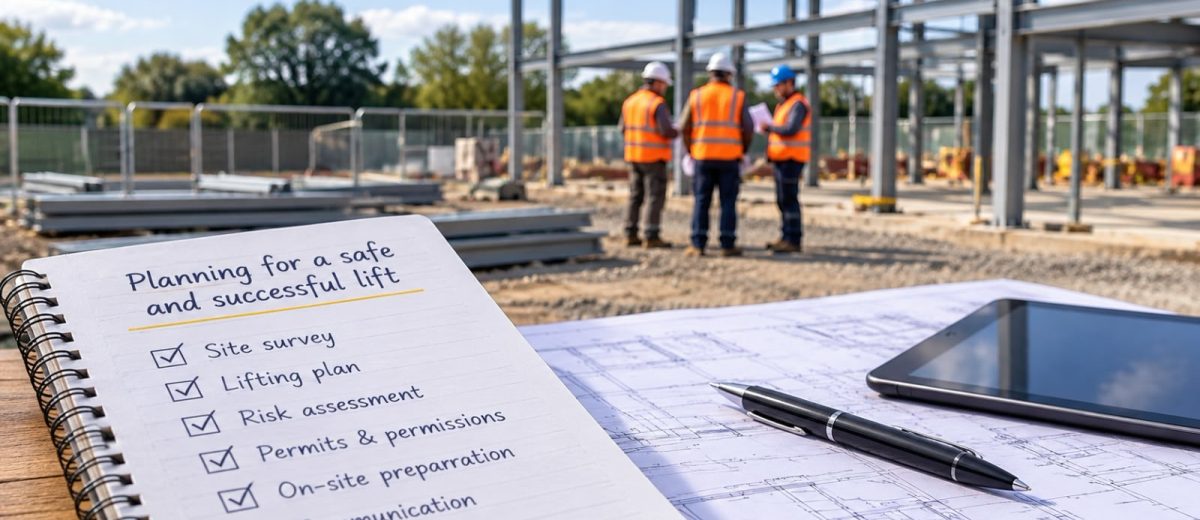
Lift Planning: What Happens Before a Crane Arrives on Site?
When you see a crane arrive on site, it can look like the lifting operation is just getting started.
In reality, by the time the crane arrives, a lot of the important work has already happened.
The successful lift you see on site is the result of lift planning, experience and problem-solving that often begins days or even weeks beforehand. From understanding the load and assessing access to choosing the right equipment and identifying potential risks, there is a lot more involved than simply turning up with a crane.
At JT Cranes, we think a lifting project starts with a conversation, long before the crane arrives.
JT Cranes has planned and carried out lifts from Great Gransden, near Sandy, since 1981. For a contract lift we supply the appointed person, plan the lift, produce the risk assessment and method statement, and work to BS 7121 Part 3 and LOLER 1998.
It starts with understanding the job
Before recommending a crane, we need to understand exactly what you’re trying to achieve.
What are you lifting? How much does it weigh? How high does it need to go, and how far does it need to travel? Where does the lift start and finish? What does the access look like? Are there restrictions on height, width or ground conditions?
These details can change the equipment and the approach.
A crane that looks ideal on paper might not actually be practical once you take the site conditions into account. That’s why experience matters. At JT Cranes, our team can often identify potential problems early and suggest a more practical way of approaching the lift.
Our mini crane hire service includes a wide range of compact lifting equipment, but choosing the right machine takes more than matching the lifting capacity to the load. The crane needs to work safely and effectively within the environment it’s going into.
Site access is often the first challenge
Getting the crane to the lifting position can be just as important as the lift itself.
For projects in restricted spaces, access may involve narrow entrances, tight courtyards, low headroom or internal access through a building. There may also be concerns around flooring, ground conditions, overhead obstructions or the route the crane needs to travel.
This is one of the reasons mini cranes are so useful. Our two smallest machines, the SPX328 and SPX532, fit through a single doorway. The SPX650 and SPX1280 need a double doorway and still lift up to 8,000 kg.
But even with compact equipment, these things need to be considered before the crane arrives.
The lift needs a plan
A contract lift is where the crane company takes responsibility for planning and managing the whole lifting operation, including supplying the appointed person. With crane hire alone, that responsibility stays with you and your team.
For more complex lifting operations, planning is most of the work.
This can include assessing the risks, determining the lifting method, selecting the appropriate equipment, considering the ground conditions and producing the necessary documentation. For contract lifts, an Appointed Person is responsible for planning the lifting operation and making sure the work is organised and controlled.
JT Cranes’ Contract Lifting service is designed for customers who don’t have the specialist expertise in-house. The division is headed by Darren Lee, our appointed person, and the team takes responsibility for the lifting operation, including lift planning, risk assessments, method statements, crane selection and on-site supervision.
That means potential problems can be identified before they become problems on the day.
The crane is only part of the job
It’s easy to think of the crane as the main consideration, but there’s much more to a lifting operation than the machine itself.
Lifting accessories such as slings, chains, spreader beams and glass lifters may be required, depending on the job. The positioning of the crane, the working radius and the weight and shape of the load all need to be considered.
There also needs to be a clear understanding of who is responsible for each part of the operation.
This is where an experienced crane company earns its fee. The aim is a lifting operation that works in practice, with the crane as one part of it.
What happens on the day?
By the time the crane arrives, the groundwork should already have been done.
The machine will need to be positioned correctly, set up and checked before lifting begins. The team on site should understand the lifting plan and their responsibilities, and the area around the lift needs managing.
For straightforward crane hire, the customer’s team may take responsibility for the planning and operation. For a contract lift, JT Cranes takes responsibility for managing the lifting operation.
Either way, good preparation means the crane can arrive ready to do its job rather than becoming the starting point for a series of last-minute decisions.
Good lifting starts long before the lift
Something unexpected turns up on most lifts. The best projects are the ones where the likely problems were spotted early and a sensible plan was ready for them.
That’s why we encourage customers to involve us as early as possible.
Whether you’re planning a construction project, an installation, a refurbishment or a particularly challenging lift, talking to a lifting specialist early can help you understand what’s possible, what equipment you’ll need and where the problems are likely to be.
At JT Cranes, we’ve been solving lifting problems since 1981. From mini crane hire and contract lifting to specialist advice and equipment, our team can help you find a practical way to do it before the crane ever reaches site.
Planning a lift?
Don’t wait until the crane is booked to start thinking about the lift.
Talk to the JT Cranes team about your project on 01767 677155 or get in touch with us online to discuss your requirements. A little planning early on saves a lot of trouble on the day.